
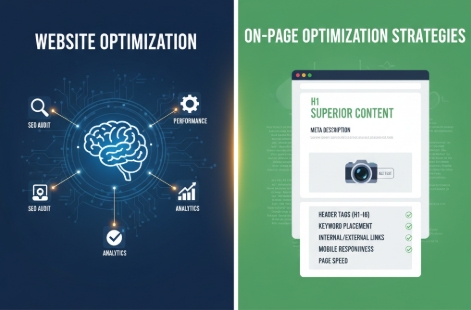
Over the years, the focus has largely been on off-page techniques – such as link building – and other technical elements.
But the reality is that SEO won’t work unless we pay attention to the basic fundamentals of on-page SEO.
There needs to be a consistent prioritization of smart SEO specialists. The craving for knowledge among people has increased, and it’s essential to stay updated with on-page SEO best practices to deliver the desired results.
On-page SEO (also called on-site SEO) refers to the practice of optimizing individual web pages to increase organic traffic and improve their rankings.
In addition to publishing relevant, high-quality content, on-page SEO includes optimizing your headlines, HTML tags (title, meta, and header), and images. It also involves ensuring your website demonstrates a high level of expertise, authoritativeness, and trustworthiness (E-A-T).
On-page SEO considers various elements of a webpage that, when combined, improve your website’s visibility in search results.
On-page SEO is critical because it helps search engines understand your site and its content, as well as determine whether it’s relevant to a searcher’s query.
As search engines have become more sophisticated, there is now a greater focus on relevance and semantics in search engine results pages (SERPs).
Google, with its complex algorithms, is now much better at:
- Understanding what users are actually searching for when they type a query.
- Delivering results that meet user intent (informational, transactional, or navigational).
Adapting to these advancements is essential. You can achieve this by ensuring your site and its content – both what’s visible to users on your webpages (e.g., text, images, video, or audio) and the elements visible only to search engines (e.g., HTML tags, structured data) – are optimized according to the latest best practices.
Moreover, you cannot ignore on-page SEO, because you have far more control over on-site factors compared to off-page SEO, which largely depends on external signals such as backlinks.
Paying close attention to these aspects will help improve your content quality and authority, ultimately boosting your rankings, traffic, and conversions.
E-A-T (Expertise, Authoritativeness, and Trustworthiness) is the framework Google uses to evaluate content creators, pages, and websites. There is a clear connection between what Google considers high-quality content and what appears in search results.
The title tag is highlighted in search engine results pages (commonly used as the clickable link) as well as in the browser window. While the title tag by itself has only a small direct impact on rankings, missing, duplicate, or poorly written title tags can negatively affect your SEO performance. Therefore, it’s crucial to optimize this element.
Since the early days of SEO, meta descriptions have been an important area of optimization.
A well-optimized meta description can improve:
- Click-through rates (CTR).
- Perceptions of the quality of the result.
- Users’ understanding of what your site offers.
If you want your content to perform well in search, start by crafting compelling headlines.
Creating a title for a blog post may seem simple, but a great headline can mean the difference between a click and an impression. That’s why it’s crucial to make headlines engaging and relevant.
Your headlines should spark interest so they stand out in the SERPs and entice users to click and continue reading your content.
Header tags (H1–H6) are HTML elements used to distinguish headings and subheadings from the rest of the text.
Although header tags aren’t as critical for rankings as they once were, they still serve an important purpose for both users and SEO.
They can indirectly influence your rankings by:
- Making your content easier and more enjoyable for visitors to read.
- Providing keyword-rich context about your content to search engines.
SEO Writing
There’s a strategy behind writing effective SEO content – it’s more than just keyword research and placement.
The key is to remember that you’re writing for people first, so the content must be high-quality, substantial, and relevant.
Content Audit
Most content creators focus on producing new material and often neglect auditing their existing content. This is a mistake.
Reviewing your existing content is essential because it helps you:
- Evaluate whether your current content is achieving its goals and generating a good return on investment (ROI).
- Identify information that has become outdated or inaccurate.
- Determine what types of content perform best for your audience.
Regular content audits can significantly enhance your SEO strategy.
What matters most is how you engage your audience with your content.
Optimizing your website’s SEO elements is only half the battle; the other half lies in ensuring that visitors stay on your site, interact with your content, and return for more.
In a competitive market like India, companies need to work especially hard.
SEO companies in India must establish themselves and deliver a wide range of high-quality content to meet the growing demand for knowledge.
Retaining engaged users is a challenge in itself, but it’s achievable.
To boost user engagement, focus on factors such as site speed, user experience, and content optimization, among others.